
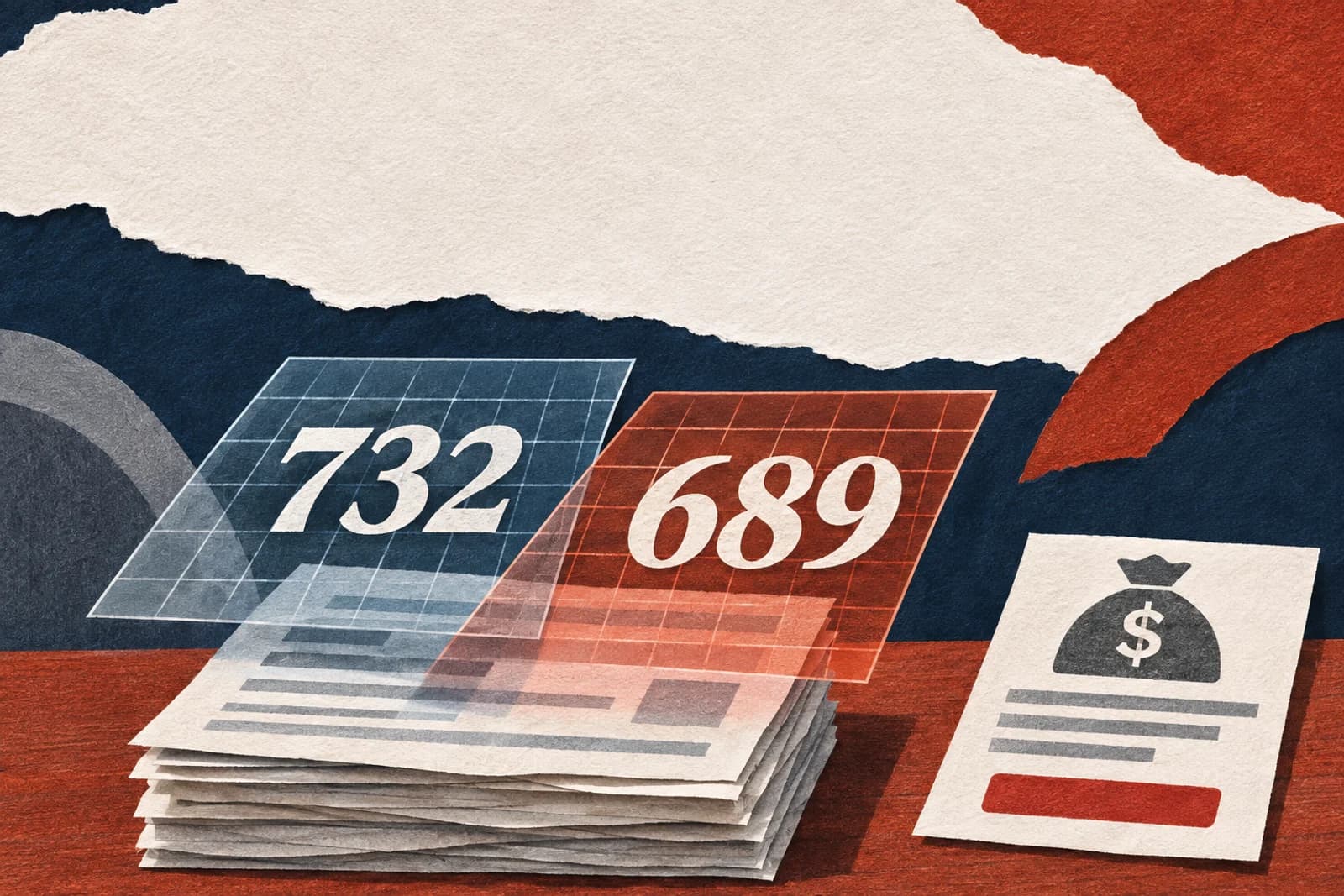
Three numbers, three different questions
Maya, a fictional car shopper, sees a credit score of 742 in her card app on Monday. A lender disclosure shows 711, and a written offer quotes a 7.4% annual percentage rate, or APR. The numbers are made up, but the questions they raise are familiar. Did her credit get worse? Is one score wrong? Did the lender charge more because it saw the lower number? The documents, on their own, do not answer those questions. The first two numbers are estimates produced by scoring models. The third describes the cost of credit in a proposed transaction. Behind the scores is another object worth inspecting: the credit report.
A credit report is a bureau’s record of credit information associated with a person. An account entry can show a balance and a history of how the account was paid. That entry is a claim about what was reported, not a judgment about whether the person should qualify for an auto loan. If Maya wants to know whether a particular card is listed or whether a payment is marked late, the report is where she can look for that detail. Neither 742 nor 711 identifies the account, the balance, or the payment entry that went into the calculation.
A credit score answers a different question. As the Consumer Financial Protection Bureau explains, a scoring model uses credit information to estimate credit behavior. The number is the output of a particular calculation, not a fact recorded on an account like its opening date. The CFPB identifies the source of the data, the model, the intended use, and the calculation date as reasons scores can differ. An app score and a lender score can therefore both be valid outputs without being interchangeable. The useful comparison starts with what each number measures and what information the model had when it produced it.
The decision on Maya’s car loan adds another step. The CFPB’s auto finance guidance says a lender may consider credit history, income, debts, and the down payment alongside the score. Some of that information comes from the application or the proposed deal rather than from the bureau file. For instance, how much Maya plans to put down is a fact about this purchase. A score shown in her card app does not say what she is asking to borrow or what the lender has learned about her income. The lender weighs the information it uses to decide whether to offer credit and on what terms.
The difference of 31 points is real arithmetic, but it is not a measurement of how much Maya’s credit changed over the week. That interpretation would depend on the scores being comparable in the first place. The app display could reflect a different calculation date, the lender could have drawn on a different bureau, or the two could have used different scoring models. More than one of those things can be true. Even the assumption that both numbers sit on the same scale needs checking. FICO, for example, publishes different ranges for its base scores and its industry-specific scores.
Nor can Maya work backward from 7.4% to a particular problem in her credit file. The written APR tells her what the lender is offering on the transaction described, not which input determined the price. Even if the disclosure identifies 711 as a score used for the loan, it does not show what would have happened if the lender had instead used 742. The numbers might not be substitutes under the lender’s process, and the score is only one potential input. Calling the offer a penalty for a 31-point drop would assume both a drop and a pricing decision that the documents do not establish.
Suppose Maya’s app shows 742 beside a green badge, while the lender disclosure lists 711 beside a credit bureau’s name. The badge reflects how the app presents its number; it is not a lender’s approval category. The bureau name is a more useful clue, but it does not, by itself, identify the scoring model or tell Maya whether the two calculations used the same information. If the documents leave those details out, the cause of the gap may remain uncertain. That is different from concluding that either company calculated a score incorrectly.
The distinction matters when Maya decides what to inspect first. A question about a listed account belongs with the underlying report. A question about whether 742 and 711 describe the same thing starts with the details attached to the scores. A question about the price of this particular loan belongs with the written offer and the transaction it describes. The score gap can be a reason to look at those documents side by side. To identify a reporting mistake, though, Maya would need evidence about a specific entry, not just two different scores or an APR she did not expect.
Same model, different bureau
Imagine two scores calculated for the same person on June 12 with exactly the same model and version. Only the input changes: one calculation uses a file from one nationwide credit bureau, and the other uses a file from another. In the first report, a credit card with a $2,000 limit shows a $750 balance dated June 8. In the second, the same card shows a $200 balance dated May 8. In this hypothetical, every other input is identical. The calculations took place on the same day, but the card information available to them was not equally recent.
That difference is enough to give the model different information about the account. The CFPB identifies the source of report data as one reason scores vary, and FICO says the bureau file available when a score is requested can differ by agency. What the two balances do not tell the reader is how many points the difference would produce, or even whether the displayed scores would differ in this example. What can be established is narrower: the model did not receive the same account balance in both runs, even though the scoring date and model matched.
To judge whether either entry is inaccurate, the relevant comparison is with the card records for the date each entry describes. Suppose the statements show exactly $200 in May and $750 in June. The amounts then line up with two different snapshots. The May entry is older, but that alone is not evidence it misstated the May balance. Now change the example: both bureaus identify June 8 as the date of the balance, and one lists $750 while the other lists $1,750. If the issuer’s records confirm the amount for that date and the figures refer to the same account and balance field, there is a concrete discrepancy to investigate.
Dates are useful only if they describe the same event. A bureau might show the date it generated a report near the top of the document and a separate date for the account information farther down. Seeing June 12 on both reports would not make the May balance a June balance. Likewise, a current balance shown in the issuer’s app is not necessarily the figure the bureau entry is meant to capture. A reader comparing the files can note the account, the reported amount, and the date associated with that amount rather than going by the report’s cover date alone.
A missing account poses a different question. Imagine the first report contains the card, while the second contains no matching entry. That comparison establishes an absence in the file being reviewed, not why the entry is absent. It does not show that the issuer never provides information about the card to that bureau, that an entry was deleted in error, or that the score must have moved in a particular direction. Before assigning a cause, the reader can verify that the first entry really is the account in question, then check what the issuer’s records establish about it and what information the issuer can confirm it supplied.
A score dashboard’s account summary is a poor substitute for that comparison. If an app does not show a card, the screen alone may not establish whether the underlying bureau report omitted it or whether the summary simply did not display it. Looking at the reports themselves also allows a third comparison. If two bureaus show the June balance and one still shows May, that pattern makes the difference in account dates easy to see. It still does not prove that the third bureau made a mistake. If two show conflicting information for June, the issuer’s dated records are more useful for checking accuracy than a vote among the bureaus.
For a consumer trying to isolate a mismatch, obtaining the Equifax, Experian, and TransUnion reports close together reduces the chance of confusing a difference between bureaus with an update that happened between requests. The official centralized service, AnnualCreditReport.com, provides access to the reports, and the Federal Trade Commission says each bureau’s report is available free online once a week through that service. Pulling them together does not synchronize the bureaus’ information. It gives the reader three records to inspect under roughly the same conditions. A newly obtained file also may not reproduce the exact information available when an earlier score was calculated.
The useful finding is one that names what differs: the same card appears with balances from different months; a card is present in one file but absent from another; or an entry for a specific date conflicts with the issuer’s records. Those are different findings even if each first came to light through the same score gap. The FTC distinguishes correcting a mistake from trying to remove accurate, current negative information. A discrepancy supported by account records gives a consumer something specific to raise. A lower score attached to one bureau’s file does not, by itself, identify any information to correct.
A payment, a statement and a score run on different clocks
Consider a fictional card account whose statement closes on July 2 with a $640 balance and a July 24 due date. On July 5 the issuer updates a bureau with the $640 statement balance. The cardholder pays $640, and the payment posts on July 10. With no new charges in this example, the issuer now shows nothing owed. On July 12 a score is calculated using that same bureau’s file, which still shows the $640 balance. The cardholder sees the score in a dashboard on July 16. The dates are illustrative, not a schedule an issuer, bureau, or app is expected to follow.
There is no contradiction between a zero balance at the issuer on July 16 and a bureau entry showing $640 as of the earlier update. They describe the account at different points. FICO says the last statement balance is generally what appears on a credit report. That helps explain why a payment can be fully posted before a score is calculated and still not be reflected in the balance used for the score. It does not mean every issuer sends the statement balance on a particular day, or that the statement closing date is necessarily the day information reaches a bureau.
Keep the bureau and scoring model fixed and move the calendar forward. In this example, the next statement closes August 2 at zero, the issuer sends an update reflected in the bureau file on August 5, and the same model calculates a new score on August 7. This time the calculation has a zero balance for that card. Whether the dashboard displays the August 7 score right away is a separate matter. It might still show the July calculation after the bureau file has changed. The date a consumer opens an app is not evidence that a score was recalculated that day.
The sequence shows why timing matters even when two scores carry the same model and bureau labels. The July calculation and the August calculation could receive different balances because they used the file at different times. The example isolates one change, but an actual file can change in more than one place between calculations. A newer score alone would not show that a particular payment accounted for the difference, and the balance change does not translate into a known number of points. A report update and a score refresh are observable events; the effect of one account update on the resulting score is a separate question.
For someone trying to place a displayed score on that calendar, the useful dates come from different records. The statement identifies the balance at closing and the payment due date. The issuer’s account activity shows when a payment posted. The bureau entry shows the balance and any associated date available in the file. A score display or disclosure may say when the score was calculated. If the app gives only a date it updated the dashboard, that date should not be substituted for the calculation date. An unavailable date is a limit on what the comparison can establish, not a reason to assume the dates match.
A payment status deserves a different check from a balance. Suppose an August bureau entry in the same fictional example marks the July payment late, even though the issuer’s records show the full $640 payment posted on July 10 against the July 24 due date. If the status refers to that obligation, there is a specific inconsistency worth investigating. The July balance can still have been reported accurately. Showing an amount outstanding before a payment and saying the customer failed to pay on time are different claims, and evidence that supports the first does not support the second.
The timing details matter in the other direction, too. A receipt showing when someone initiated a payment is not necessarily a record of when it posted or how the issuer applied it. A later payment also does not, by itself, contradict a late status for an earlier billing period. An account could now be paid while a historical record of lateness remains accurate. The comparison needs the due date, the relevant payment record, and the month or obligation the bureau entry describes. In the July example, it is the match between the posted payment and the same obligation, not simply the current zero balance, that makes the late status worth checking.
A person looking at the July 16 dashboard could reasonably know that the issuer had credited the payment without knowing when a score would first reflect it. FICO’s general description of statement balances does not supply that issuer’s reporting calendar, and the dashboard may have its own refresh interval. Those gaps in knowledge matter most when a consumer is trying to explain a number seen on a particular day. The dated statement can support the earlier $640 balance, the issuer’s payment record can support an on-time payment, and the calculation date can show whether the score was even in a position to reflect a later update.
What a utilization ratio can explain, and what it cannot
Suppose a credit report shows two fictional cards. One has a $900 reported balance and a $1,000 credit limit. The other has a $100 reported balance and a $4,000 limit. The first card is using 90% of its limit, and the second is using 2.5%. Across the two cards, the report shows $1,000 in balances against $5,000 in limits, for combined utilization of 20%. All three percentages are correct. They answer different questions: how much of each card’s limit is in use, and how much of the combined limit is in use.
Combined utilization divides the sum of the balances by the sum of the limits. It is not an average of the two card percentages. The $4,000 card supplies most of the available limit in this example, even though it accounts for only $100 of the balance. Looking solely at the combined 20% would hide how close the first card is to its own limit. Looking solely at the 90% would miss the unused capacity on the second card. Neither percentage is a score or a grade. Each describes a relationship between balances and limits in the underlying data.
That difference becomes clearer if the same $1,000 is distributed differently. Imagine instead that the $1,000-limit card reports $200 and the $4,000-limit card reports $800. Both cards are now at 20%, and the combined figure is still 20%. The total owed, the total limit, and the number of cards reporting balances did not change, but the per-card figures did. FICO’s guide distinguishes revolving utilization from other amounts owed and says its scoring considers how many accounts report balances. An app that shows only combined utilization does not show all those details. The two distributions illustrate a difference in inputs, not a prediction that one will produce a particular point advantage.
The denominator can also change without anyone borrowing more. In a separate fictional file, one card reports $600 on a $3,000 limit and an unused card reports zero on a $2,000 limit. Counting both limits gives combined utilization of 12%. If a later calculation no longer counts the unused card’s limit, the same $600 is measured against $3,000 instead of $5,000. Combined utilization is then 20%. The first card is at 20% in both snapshots. This is arithmetic conditional on which limits are included, not a rule about exactly when a closed or otherwise unavailable line drops out of a particular calculation.
A reported card balance also does not establish that the cardholder is paying interest. Imagine a cardholder whose $900 statement balance is reported and who then pays the full statement amount by the due date. If the purchases qualify for a grace period, that balance can appear in the credit data without the cardholder incurring interest on those purchases. Conversely, the utilization fraction alone cannot tell a reader whether a balance is accruing interest or what that interest will cost. The statement and account terms answer questions about interest. The balance and limit in the bureau file answer the narrower question about reported utilization.
An installment loan belongs on a different line of the calculation. Suppose the same report lists an auto loan originally taken out for $20,000, with $12,000 remaining. The original $20,000 was an amount borrowed, not a revolving limit the borrower can draw against again as payments come in. Adding it to the two cards’ $5,000 of limits would make the card utilization figure look smaller without adding any revolving capacity. The remaining $12,000 is still debt, and FICO’s guide discusses installment amounts separately. Leaving the auto loan out of the card ratio does not mean leaving it out of the credit report or assuming a scoring model ignores it.
A round-number target cannot resolve these distinctions. A dashboard might flag a combined ratio above a particular percentage, but the flag does not establish that a lender’s model applies a cutoff there. Two files at the same combined ratio can have different per-card balances, different numbers of accounts with balances, and different histories. FICO also describes versions that can evaluate earlier balances and limits, not just the latest pair of figures. Crossing a line on a dashboard can establish that its arithmetic crossed the line. It cannot establish how many points changed, whether that was the reason a score moved, or what score a lender would see.
The ratio is most useful when it narrows a question about the file. If a dashboard’s percentage rose while reported card balances stayed fixed, the included limits are worth comparing. If the combined number stayed flat while one card’s share rose, the per-card entries can show a shift that the aggregate concealed. And if a balance looks high only because the cardholder is comparing it with a more recent payment, the dates matter before the amount is treated as wrong. Each check can identify what changed in the data, or what a summary left out, without turning a percentage into an explanation for a lender’s score.
Why the name and version matter more than the brand
Take the bureau and the calendar out of the comparison. In a fictional example, an app shows 720 and a lender disclosure shows 696. Both scores were calculated on June 12 from the same unchanged Experian file. The app identifies its score as FICO Score 8; the disclosure identifies FICO Auto Score 8. The different result in this example does not require an account update or a missing entry. The calculation changed. The Consumer Financial Protection Bureau identifies the model and the score’s intended use as reasons scores can differ, even apart from differences in the report data.
The labels identify several things at once. FICO is the scoring company; FICO Score is a family of scores, not the name of a single calculation used everywhere. The number in FICO Score 8 identifies the version of the base model. In FICO Auto Score 8, the word “Auto” identifies an industry-specific variant. The shared brand and version number do not make the base and auto models interchangeable. A card issuer or monitoring service can display a score without being the company that developed the model. Similarly, a bureau label identifies the source of the file in this example, not which calculation produced the number.
Here is how the app entry could be recorded, using only details supplied in the fictional display: value, 720; score provider, Experian; full model, FICO Score 8; bureau file, Experian; range, 300 to 850; calculation date, June 12. Here is the corresponding lender entry: value, 696; score provider, Experian; full model, FICO Auto Score 8; bureau file, Experian; range, 250 to 900; calculation date, June 12. In this example both documents explicitly name Experian as the score provider as well as the bureau. The card app and the lender are the places the numbers appear, which is separate from who supplied them.
Now imagine a third screen with a different level of detail. It says “720 FICO Score” and “Dashboard updated June 12,” but gives nothing else. Its annotation would read: value, 720; score provider, unknown; full model, unknown beyond the FICO family; bureau file, unknown; range, unknown; calculation date, unknown. June 12 can be recorded separately as the dashboard update date. The matching value does not establish that the third screen is displaying the first score. Nor does the familiar brand supply the version or justify filling in the 300-to-850 range. The missing fields limit the comparison rather than pointing to an error.
FICO publishes a range of 300 to 850 for its base scores and 250 to 900 for its industry-specific scores, including its Auto and Bankcard variants. A value of 720 fits both ranges. It can be tempting to convert the number by measuring its distance between the endpoints: 720 is about 76% of the way from 300 to 850 and about 72% of the way from 250 to 900. Those are positions on two numerical scales, not percentiles among borrowers. The endpoints do not reveal how scores are distributed, how the models order particular files, or how a lender groups scores for its own decisions.
Even an exact conversion to the same fraction of the two ranges would leave the central question unanswered. It would show where a number falls on another ruler, not what the other model would calculate from the file. The CFPB’s 2012 research compared outputs from different models on credit files and found that the resulting credit-quality categories did not always match. Those were historical models and categories defined for the study, not a conversion chart or the approval tiers of a lender today. The research supports a narrower point: agreement between scores cannot be inferred from the way their scales are labeled.
In the fictional June 12 comparison, the 696 is lower as a number than the 720, but the 24-point gap is not a measured loss of credit standing. No time passed and no account changed. Nor does the word “Auto” prove that every auto lender uses that score or that the app’s base score is defective. Each number can be a valid output for the model named next to it. The lender disclosure gives the 696 relevance to this transaction if it identifies that number as a score the lender used. The product name alone would not establish that link.
The annotations also help when the goal is to track change over time rather than explain a lender disclosure. A pair of app scores with matching full model and bureau labels offers a more consistent comparison than a pair that shares only a logo. The calculation dates then tell the reader which snapshots are being compared. If the app switches versions between displays, the two numbers no longer isolate a change in the credit file, even if the bureau and scale stay the same. Recording an unknown version as unknown preserves that distinction. Guessing a model from the number would make the comparison look more conclusive than the documents allow.
When a model sees the path to today’s balance
Two fictional borrowers each have a card with a $2,000 limit and a latest reported balance of $600. Both cards are at 30% utilization in the latest snapshot. Now line up six months of reported balances, oldest first. The first borrower’s card shows $100, $200, $300, $400, $500, and $600. The second shows $1,100, $1,000, $900, $800, $700, and $600. The limit stays at $2,000 for each card throughout. The latest pair of inputs matches, but the first balance has been rising and the second has been falling. A model that looks back at those fields can see a distinction that today’s percentage cannot convey.
FICO describes that kind of lookback in its documentation for FICO Score 10T. The company says the model evaluates historical balances and credit limits over the prior 24 months or longer, rather than relying only on the latest reported month for those inputs. In the fictional example, the six months visible on the page would therefore be only part of the history the model can consider. They show why two identical latest balances need not be identical inputs to a model that looks back. They do not show what either borrower’s full record contains or how the model would weigh the histories depicted.
VantageScore describes a related approach in its technical paper on VantageScore 4.0. The company says it derives measures from histories of up to 24 months using fields such as balances, limits, and scheduled payments. That description is more specific than saying the model “looks at trends”: it identifies fields from which the model can build measures over time. It does not imply that VantageScore 4.0 and FICO Score 10T build the same measures or assign them the same importance. These are descriptions from the companies that developed the models. They explain what kinds of inputs the models can consider, not which model a particular lender uses or how an applicant will fare.
Balances are only one way the path can differ. Imagine a separate pair of cards whose reported balances stay at $600 for six months. One card has a $2,000 limit throughout. The other starts with a $1,000 limit and rises to $2,000 in the final month. Both end at 30% utilization, but only the second went from 60% to 30%, and its balance never fell. A history of both fields can distinguish a change in the limit from a change in the reported amount owed. A single current percentage, or even a series of percentages without the underlying fields, does not identify which part of the fraction changed.
A model without these trended balance and limit inputs is not necessarily blind to the past. A bureau file may show whether an account had late payments, and a model can consider that historical payment performance while using only the latest balance for a separate input. In the first fictional pair, the balances alone do not indicate whether either borrower paid on time. A rising balance might coexist with timely payments, and a falling balance does not erase a late status from a previous month. The distinction is between using a history of particular fields and using any credit history at all.
The monthly series also does not show what happened between reports. A change from $700 to $600 does not tell the reader how much the consumer paid, how much was newly charged, or whether any interest accrued. Several combinations of account activity could leave the same reported balance at the next update. Likewise, a rising sequence does not establish why the amounts rose. The example describes what the model can observe in the reported data, not a diagnosis of either borrower’s finances. More months give a model more observations of those fields, not a transaction-by-transaction view of the account.
For the same reason, the examples do not support assigning either borrower a score or predicting which will gain points under a trended model. A model can use a longer history than the six months shown, consider multiple accounts and other parts of the file, and combine inputs in ways a balance chart does not reveal. Even if an app and a lender calculated scores on the same day from the same bureau, knowing that one model uses trended data would identify a possible source of difference, not prove that this particular six-month pattern caused it. The comparison does not isolate a single factor just because one of the models uses an additional kind of information.
For someone comparing two displays, the useful question is what each model could have seen that the dashboard’s current balance does not show. If the model label is known, its documentation can establish whether histories of balances and limits are among the inputs it is designed to consider. If there is a concern about an underlying entry, the question is narrower: does a balance or limit for a particular month match the available account records for that period? The first inquiry is about how the score was built. The second is about whether a reported fact is accurate. Matching figures in the latest month settle neither question about the earlier months.
What the CFPB measured when scores disagreed

A gap between two scores tells you how far apart the printed numbers are. It does not tell you whether the models put the same credit file in roughly the same place relative to other files. That second question was central to a 2012 Consumer Financial Protection Bureau study of scores purchased by consumers and creditors. The bureau analyzed about 200,000 credit files from each of the three nationwide credit reporting companies. It compared outputs from different scoring models and examined how often the models assigned consumers to the same one of four credit-quality categories defined for the analysis.
Those categories gave the researchers a common yardstick. Rather than asking whether two models returned the same number, they asked whether the results fell into corresponding groups. If two results both placed a file in the second of the four groups, that was agreement at the category level, even if the numbers or finer rankings differed. If one placed the file in the second group and the other in the third, the study counted a one-category difference. Neither result tells you whether the models would rank two neighboring files in the same order within a group.
In the three model comparisons summarized in Figure 8, which used data from one credit bureau, the models put consumers in the same category 73% to 80% of the time. They placed consumers one category apart 19% to 24% of the time and two or more categories apart 1% to 3% of the time. The endpoints come from different comparisons, so they should not be added together as if they described a single group of files. The appendix reports results for the other two bureaus, including comparisons in which agreement was 68%.
Consider two fictional results from models that use the same numerical scale. Suppose the two models both place one file comfortably within their respective second groups, even though their outputs differ by 25 points. For another file, suppose a difference of only five points puts the results on opposite sides of the relevant group boundaries. The first pair has the larger point gap but no category shift. The second has the smaller point gap but registers a shift. These are illustrations, not data from the study. They show why a category comparison measures where the outputs land, not the distance between their values.
The study boundaries were not the score thresholds at which particular lenders approved loans or changed rates. Imagine a lender whose pricing process divides a broad study category into multiple tiers. Two results that agree under the study method could still be separated by a threshold relevant to that lender, if the scores were comparable under its process. Conversely, a shift between study categories need not correspond to any change in the terms offered. The lender may use only one of the models, and its decision may turn on information the category comparison did not examine. The study did not track those decisions.
That distinction limits what Maya, the fictional car shopper, can infer from the green badge beside her app score. If she treats the badge as a preview of a lender's pricing tier, she is assuming both that the lender's model will place her similarly and that the lender uses a comparable boundary. The 2012 research tested the first kind of agreement only in the context of its own models and categories. The CFPB's auto finance guidance explains why the second assumption is separate: a lender can take income, debts, down payment, and credit history into account alongside a score.
The research also cannot tell Maya how often a gap like hers occurs now. The files and models belong to a historical study. Its ranges are not estimates of how often an app score and a lender score disagreed in November 2026, and they are not observed odds of denial. Finding that models placed consumers one category apart in 19% to 24% of cases in the main table does not mean that share of applicants got a worse rate. The study did not measure loan outcomes, and category disagreement alone does not establish which direction a particular comparison will go.
The study is most useful when deciding how much weight to put on the app's interpretation of its own number. A dashboard can label a score relative to the groups it displays without saying anything about the lender's groups. Even if two models tend to agree across many files, a borrower cannot use that aggregate finding to decide which group describes their own application. The score label can help identify what the app measured. The lender's disclosure and written offer can show what was disclosed and what terms were offered. No percentage from the study can fill in a missing connection between the two.
No score is not the same as a low score
A blank score field leaves open a question that a number near the bottom of a scale does not. If a model returns a low score, it had a record it could evaluate under its rules and produced a result. If there is no score, there may be no record at the bureau queried, or there may be a record that the model cannot evaluate because it lacks information the model requires. A blank display may not explain which situation applies. Treating all three situations as equivalent would turn the absence of a calculation into a claim about someone's credit standing.
FICO's published minimum requirements illustrate what can make an existing file unscorable. The company generally requires at least one account that has been open for six months or more, at least one account reported within the past six months, and no deceased indicator on the report. The account that satisfies the age requirement can be the same one that satisfies the reporting requirement, but it does not have to be. FICO notes that requirements can vary in rare cases by version. These are the company's conditions for generating a score, not a lender's conditions for granting credit or another scoring company's eligibility rules.
Take a fictional bureau file for Elena. It lists her first credit card, opened two months ago and updated last week, with no other accounts and no deceased indicator. The file is not empty, and the card's recent update meets the usual FICO recency condition. But the only account has not been open for six months. A score missing for that reason would not mean the model examined two months of payments and gave Elena poor marks. Under the stated requirements, her file lacks an account old enough to qualify for that calculation. An up-to-date report can still contain too little history for a model.
A second fictional file, for Marcus, contains accounts that were opened years ago, no deceased indicator, and no account reported within the last eight months. Here the age condition is not the problem. The file contains account history, but none of the listed accounts satisfies the usual reporting recency condition. The relevant date is when an account was reported, not when Marcus last opened the dashboard or obtained a copy of the file. If the file instead included a recently reported new account, that account could satisfy recency while one of the older accounts satisfied age. The new account would not itself have to be six months old in that example.
The difference between having no record and having a record that cannot be scored also matters when researchers count people. An inquiry-only file provides a useful example. It can document that someone requested the person's credit information without listing an account. If a method puts people with such files in the no-record category, the count answers a different question than it would if the method recognized the inquiry as a record and then asked whether the record had enough information to be scored. Likewise, bringing previously excluded records into the analysis can change the measured groups without any change in the underlying credit activity.
In its 2025 technical correction and update, the CFPB distinguished people without a credit record from those with a record containing insufficient or stale information for scoring. The treatment of inquiry-only files and previously excluded records matters to that distinction. Using its revised methodology, the CFPB estimated that 2.7% of U.S. adults had no credit record in December 2020 and 9.8% had an unscored record. The observation date is December 2020, not the year the correction was published. Neither figure is a November 2026 count, and neither tells Elena or Marcus whether a particular model can score the file a lender obtains.
A lender document can provide a different kind of clue. Federal Regulation V includes an exception to the usual risk-based pricing notice requirements for certain disclosures when a score is unavailable, subject to the rule's conditions. A qualifying no-score disclosure is not the same thing as a notice showing a numerical score with a range. It does not identify a low score hidden from view, and the fact that the lender could not obtain a score does not resolve whether the bureau had no record or had one that could not be scored. A dashboard that simply shows a blank field provides even less detail about what was attempted.
For Elena, the useful evidence is an account opening date paired with a recent reporting date on the file in question. For Marcus, it is the date of the latest reported account information, even if the accounts themselves are old. Neither example establishes how a lender would handle the application, and neither establishes what a different model or bureau would return. If the record and the model are known, account dates can explain why a familiar score field is empty. If those details are unknown, a blank is not a sound basis for guessing whether the consumer has no bureau record, an unscored record, or a number the service simply has not displayed.
Where to get the record, and where to get a number
Imagine Maya has three questions after looking at her auto loan paperwork. Does a bureau list the card she opened last year? Can she see a score with enough detail to compare it with the one she sees next month? What score information has the lender disclosed for this application? Those questions point to three different documents: a credit report from the centralized request service, a score display from a card issuer or monitoring service, and a disclosure from the lender. Getting one of the three does not necessarily get her the other two. In particular, a free credit report does not include a credit score.
AnnualCreditReport.com is the official centralized service for requesting reports from Equifax, Experian, and TransUnion. The Fair Credit Reporting Act provides a statutory right to a free disclosure from each of those nationwide bureaus once per 12 months through the centralized source. The Federal Trade Commission describes a separate, more frequent option: the bureaus make their reports available there free online once a week. The weekly availability is for reports, not scores. A consumer who has already obtained an annual report does not need to read the once-per-12-month statute as a limit on that separate online offering.
The official request form identifies telephone and mail routes as alternatives to requesting reports online. The form lets the consumer choose any or all three nationwide bureaus. The mail form describes the annual entitlement; it does not establish that the weekly online option is also available by mail. For Maya's question about whether a card is listed, the report supplies the relevant evidence regardless of how she requested it. If she requests only one bureau's report, she can see whether the card appears in that file, but she cannot infer from that copy alone what either of the other bureaus shows.
For a score, the CFPB says some card issuers make one available to customers at no additional charge. Monitoring dashboards are another place consumers encounter scores. The label determines what a displayed number is useful for. Suppose Maya's card issuer gives her a number at no extra charge and names the full model, the bureau, the range, and the calculation date. If she wants to compare next month's result with this month's, those details let her check whether the model and bureau stayed the same and identify the dates she is actually comparing. The fact that she did not pay for the number does not make those details less informative.
Now suppose Maya sees a paid score described only as a credit score from a nationwide bureau. The purchase could give her another valid number, but the CFPB cautions that even a score purchased from a bureau or scoring company may not be the one a lender uses. In this comparison, the labeled no-charge score tells her more about what was calculated than the paid score with limited labeling. A paid score with complete details could answer questions about its own model and bureau, but paying does not establish a link to a particular lender. That link depends on what the lender actually used.
The FTC also warns that an offer of a free score can be tied to paid credit monitoring. That makes the price of the accompanying service a separate question from whether there is a charge for seeing the initial number. A consumer comparing two displays can check whether viewing the score requires enrolling in an ongoing service and what the terms say about charges. The statutory free-report right is not an offer to enroll in monitoring. If the question is whether an account or payment status appears in the bureau file, a score bundled with monitoring still does not substitute for the report entry itself.
Certain lender disclosures are the third route. The Fair Credit Reporting Act requires score-related disclosures when a covered lender uses a consumer credit score in connection with a consumer-initiated application for credit secured by one to four residential units. The statute's score disclosure provisions identify details such as the score range, key factors, the creation date, and who provided the score. This is a disclosure tied to a covered application, not a way to request the score that any lender might use in the future. The law also has provisions addressing automated underwriting, so a disclosure should be read for what it identifies rather than assumed to describe every input to the lender's decision.
Suppose a disclosure names a score provider and gives a creation date but does not identify the full model. Maya can record what the document says and leave the model unknown. If the date differs from her app's calculation date, she has found one difference between the records, not necessarily the cause of the gap. If she instead finds a dated card entry that conflicts with her issuer's records, that is a question she can pursue about the underlying file even if the model remains unknown. The bureau report supplies account-level evidence; the score display and the lender disclosure supply only the calculation details they actually identify.
How rate shopping can leave several entries but count as one
On Monday of a fictional shopping week, Maya requests her own credit report. On Tuesday, she asks a credit union for an auto loan quote. On Thursday and Friday, she seeks financing from two other lenders for the same car. Assume all three lenders make hard inquiries in response to her requests. When Maya later looks at the report used in this example, she sees three lender entries. The list tells her that three lenders requested her credit information. It does not tell her whether a scoring model treated those requests as three separate events.
Maya's Monday self-check belongs in a different category. The Consumer Financial Protection Bureau calls checking your own credit a soft inquiry, which does not affect credit scores. Prescreening for offers and routine reviews by an existing creditor are other examples of soft inquiries. A hard inquiry, by contrast, can be visible to others who obtain the report and can affect a score. Maya did not add a fourth hard inquiry by looking at her own file. The distinction depends on the nature of the request, not on whether it happened during the same week or involved the same credit bureau.
The Tuesday, Thursday, and Friday entries raise a question about the scoring model rather than the accuracy of the report. The CFPB explains that eligible inquiries for the same type of loan are generally grouped for scoring when they fall within a set period. In Maya's example, a model applying that treatment could count the three eligible auto inquiries as one. It can do that while the bureau continues to list all three. Each entry can accurately record a separate request even if the model does not assign each one a separate effect.
The CFPB describes a range of 14 to 45 days because different models use different windows. The three fictional auto inquiries fall within a few days of each other, so the difference between a shorter and a longer window is not the issue in that example. Now suppose Maya also seeks an auto quote four weeks after the first inquiry. Those two requests are too far apart to fit together within a 14-day window, but they could fit within a 45-day window if they otherwise qualify. A calendar can show the spacing. It cannot reveal which window a lender's model applies.
Now add a mortgage application on Wednesday and assume it also results in a hard inquiry. It falls between the auto inquiries, but it is for a different type of loan. The CFPB's explanation does not turn the whole week into one scoring event just because all the requests arrived close together. A model could group the eligible auto inquiries and treat the mortgage inquiry separately. If Maya instead submitted several credit card applications that week, the auto example would not establish that those card inquiries qualify for the same grouping. Timing is only one part of the rule.
Grouping also does not mean immunity from a score effect. Counting three eligible requests as one is different from ignoring the one. And if Maya's app shows a lower score after the shopping week, the sequence alone does not establish how the inquiries were treated. A score calculated before Friday could not reflect Friday's request. A later calculation might use a different bureau file, or the file might have changed in other ways while she was shopping. Neither the number of lines in the inquiry list nor a before-and-after point difference isolates what the scoring model did with those requests.
In practice, the word “quote” does not settle what type of inquiry a lender will make. One lender might describe terms based on information a shopper provides, while another might request a report before making an offer. Even a process that starts with a soft check can have a later application step that involves a hard inquiry. A more useful question at a particular screen is whether submitting that form triggers a hard inquiry now, rather than whether the lender uses the word “quote” or “preapproval.” The answer for one step does not necessarily describe the rest of the process.
Suppose the Friday entry is the one Maya wants to understand. The lender's application confirmation can help her match the request to the date she submitted it, and the report can show how the inquiry was recorded. If the name on the report is unfamiliar, the paperwork may help identify which lender actually handled the financing request. Those checks address who accessed the file and when. Whether the Friday inquiry was counted with Tuesday's is a separate question that depends on the model and the inquiries it received. A report can answer the first question without answering the second.
What preapproval actually establishes
Consider three fictional documents: an email inviting Jordan to apply for a credit card, a mailed prescreened firm offer for another card, and a mortgage preapproval letter. Each sounds like progress toward borrowing, but each comes from a different stage. The email may establish little beyond the fact that an issuer is soliciting applications. The firm offer means the issuer screened Jordan against criteria before sending it. The mortgage letter describes how much a lender might lend based on a preliminary review. The difference is not how confidently each document is worded. It is what the creditor has evaluated and what remains to be decided.
Start with the email. Its subject calls Jordan a prequalified customer, but the body invites Jordan to submit an application and says nothing about a review of credit information. Perhaps it was sent to existing customers based on their relationship with the bank. The email does not establish that the bank reviewed Jordan's report or verified income, and the absence of that information does not prove what the bank did behind the scenes. What the document establishes is that the bank is asking Jordan to apply. A button that opens an application is not evidence that the application has already been evaluated.
The second document explicitly identifies itself as a prescreened firm offer of credit. The CFPB distinguishes that from a general invitation to apply: the recipient was selected through screening, and the offer is firm if the applicable conditions are met. Jordan still has to apply to obtain the card. At that point, the issuer may check updated credit information to see whether Jordan still meets the relevant criteria and may verify that Jordan has sufficient income. An account that was current at screening but now shows a late payment could matter, for example, if the applicable criteria address that change. The mailing establishes prior selection, not that all conditions have already been satisfied.
The original prescreening is an example of a soft inquiry, which does not affect credit scores, according to the CFPB. That does not establish how the issuer will check credit if Jordan responds and submits an application. A past screening and a new credit request can be separate events. Conversely, the invitation in the first email does not become evidence of a hard inquiry merely because Jordan sees a form asking for personal information. The useful distinction is between what has already happened and what submitting the form would authorize the issuer to do next.
The third document comes from a different process. Suppose the mortgage letter says the lender reviewed Jordan's credit and the income documents Jordan provided and would tentatively lend up to a stated amount. The letter makes that assessment subject to verification of the information and review of the property once Jordan has found one. It can establish that a lender has taken a preliminary look at the borrowing request. It cannot establish that an eventual property will qualify or that the final loan will be approved. In this example the letter says credit was checked, but it does not identify whether the check was soft or hard.
The CFPB notes that mortgage lenders do not necessarily use “prequalification” and “preapproval” in the same way. One lender might issue a letter after reviewing documents, while another might use similar language after a more limited assessment. Rather than treating the labels as standardized steps, compare what two letters say was reviewed. A letter based on stated income leaves a different question open from a letter based on pay records, even when both carry the same heading. Neither heading establishes which credit check occurred or whether the lender will obtain updated information before making a final decision.
A mortgage preapproval letter also is not a standardized Loan Estimate. Suppose Jordan has a letter stating a tentative borrowing limit but has not yet chosen the home. That limit does not supply the expected rate, closing costs, and other terms for financing a specific purchase. A Loan Estimate describes expected terms for a covered mortgage; the CFPB cautions that it is not approval either, even if the rate has been locked. The preapproval letter can indicate how far the lender has gone in assessing the borrower. The Loan Estimate can describe the expected terms of a particular loan. Neither commits the lender to fund it merely by being issued.
The next step differs for each document. For the email, Jordan may still need to find out what the bank will evaluate for the first time. For the firm offer, the relevant conditions are those the issuer can check when Jordan responds, not whatever the word “preapproved” might suggest in another solicitation. For the mortgage letter, the written conditions identify which parts of the review are still open. If avoiding an unexpected hard inquiry is the immediate concern, a specific question about the next form or submission addresses that concern better than comparing the language at the top of the three documents.
Why the same auto score can produce different offers
Put Maya's written auto offer beside a second version from the same lender. In this fictional comparison, keep the car, sale price, loan term, credit file, and score of 711 fixed. Change only her proposed down payment, from $2,000 to $5,000. With fees and everything else held constant, the second version requires $3,000 less financing. That difference is known before anyone explains the lender's pricing. The lower amount borrowed is a feature of the proposed purchase, not evidence that the score improved or that a balance on Maya's credit report was corrected.
If both versions carry the same interest rate and repayment schedule, borrowing less reduces the payment and the total interest in this example. But nothing about the down payment guarantees that the rate will be the same, lower, or higher. The CFPB lists down payment among the factors a lender can consider when setting an auto loan rate. The lender might price the smaller loan differently because the amount financed is lower relative to the car's value, or it might offer the same rate on both versions. The written terms are what show whether the rate changed. The down payment figure alone does not.
The extra $3,000 up front matters even if the second version has a lower monthly payment. Without a breakdown, Maya cannot tell how much of the payment difference comes from borrowing less and how much comes from any change to the rate or term. In this example, the term was deliberately kept fixed to make the comparison easier. If a real quote changed the repayment period too, the payment would reflect another change. A lender can describe two offers accurately while emphasizing the monthly payment on both. That figure does not show how much cash Maya would have to put into each deal at the start.
Now reset the down payment to $2,000 and change only the lender. Assume both lenders use the same model and bureau information and obtain the same 711. They are considering the same car, amount financed, and requested term. They can still price the loan differently. A lender might group applications into pricing tiers, for example, with each tier associated with a different set of terms. The other lender need not draw the boundaries in the same places, use the same additional inputs, or charge the same rate even when the two lenders put an application in broadly similar groups. There is no implied market-wide cutoff at 711.
The CFPB's auto finance guidance identifies credit history, income, and existing debts as other possible inputs. They do not all come from the same place. The report can show listed obligations and how they have been paid, while the application and any supporting records can supply income information. A lender can consider how the proposed payment fits with that income and those obligations. Two lenders can have the same score and the same application figures and still assess the transaction differently. Neither lender needs to alter the score to reach its decision, and the score disclosure does not show how much weight each lender placed on the application figures.
Consider one possible difference in how those inputs are used. One lender might first use credit information to assign a pricing tier, then look at income and debts to decide whether the requested amount is within what it will lend. Another might consider the amount financed and details of the car when setting terms within a tier. These are illustrative processes, not claims about what Maya's lender did. They show why two loans can carry different APRs even after the score and proposed purchase have been matched. The APRs do not reveal which lender used more tiers or which piece of information made the difference.
A competing quote also does not, by itself, establish that a lender charged a higher rate because of Maya's credit report. Regulation V's risk-based pricing rule, subject to exceptions, concerns materially less favorable terms based wholly or partly on a consumer report, measured against the most favorable material terms available to a substantial proportion of that creditor's consumers. A lower rate from another lender is not that comparison. Nor does an advertisement establish that Maya would qualify for the advertised terms on this transaction. A pricing difference is observable on paper; its cause is not necessarily disclosed by the two prices.
At the point of comparison, Maya can put the amount financed, APR, interest rate, term, and monthly payment from each written offer on separate lines. If the amount financed differs, she can check whether the difference comes from cash down, fees, or something else included in the deal. If the term differs, the payments are spread over different numbers of months. Only after those differences are visible can she tell whether she is comparing two prices for the same financing or two differently structured transactions. The score is an input the lenders may share. The written terms are the obligations Maya can compare.
Mortgage models: permitted, in use and planned are not synonyms

Suppose Jordan's mortgage preapproval letter says the lender reviewed credit, and a second lender says it can use VantageScore 4.0. Those statements answer different questions. The first describes a step the lender says it took; it does not name the model. The second describes an option; it does not say the lender used that option for Jordan. To see why the distinction matters, consider the rules for loans delivered to Fannie Mae or Freddie Mac. The Federal Housing Finance Agency's policy sets out which models can be used for eligible loans delivered to those enterprises. It is not a rule that assigns one model to every mortgage application in the United States.
On September 9, 2026, Fannie Mae and Freddie Mac expanded access to VantageScore 4.0 to all approved lenders for eligible loans, without requiring prior written approval. FHFA's October policy page also explains that lenders can continue using Classic FICO under the interim policy. The September change therefore widened the choice; it did not require a switch. In Jordan's hypothetical, one approved lender could use VantageScore 4.0 for an eligible loan while another continues to use Classic FICO. Even if both lenders describe their loans as eligible for delivery to the same enterprise, that description alone would not identify the calculation either performed.
There is a limit to that choice within a single loan. Suppose Jordan and a co-borrower apply together. Under the interim policy, the lender must use the same model for all borrowers on that loan. It cannot use VantageScore 4.0 for Jordan and Classic FICO for the co-borrower as a way to pick a preferred result for each. Using the same model does not mean the borrowers should have the same score. Their credit files can contain different accounts and payment histories, and the policy's requirement concerns the calculation used, not the values it returns. A different lender considering the same pair might make a different permitted model choice for the loan.
The number of bureau reports is a separate question. A lender can obtain a combined report that presents information from multiple bureaus. Combining those records is not the same as combining scores, and it does not select a scoring model. Imagine a mortgage file that contains a combined report and lists multiple scores for Jordan. The headings next to the scores might identify different bureau sources even when all the calculations use the same model. Conversely, a reference to the bureaus included in the report does not tell Jordan whether the lender chose Classic FICO or VantageScore 4.0. The report identifies sources of credit information; the model label identifies how a score was calculated from credit information.
On November 24, 2026, FHFA published a roadmap for implementing FICO 10T, which it had announced as validated and approved in October 2022. The roadmap targets December 2027 for pilot activity, April 2028 for a limited rollout, and September 2028 for broad eligibility and the retirement of Classic FICO. FHFA labels the dates after November 2026 as targets subject to change. Model approval did not make FICO 10T broadly eligible for loan delivery, and the planned retirement does not remove Classic FICO from the interim policy while it remains an option.
Publication of historical score data is another milestone that can be mistaken for a launch. Historical data let people examining the transition see results for past files. Publication does not mean a lender can deliver a newly originated loan to an enterprise using FICO 10T in live operations. Even the pilot and limited rollout are distinct from the planned opening to a broader set of eligible loans. If Jordan encounters a reference to historical FICO 10T data while reviewing a November 2026 preapproval, that reference does not establish that the lender has used the model for the application. It describes information available for examining the transition, not what happened in Jordan's file.
A lender's statutory disclosure answers yet another question. The Fair Credit Reporting Act requires score-related disclosures when a covered lender uses a consumer credit score in connection with a consumer-initiated application secured by one to four residential units. The statute addresses what must be disclosed, including details such as the score's range, creation date, provider and key factors, and has provisions for automated underwriting. It does not dictate which model every mortgage lender must use. The enterprise policy, by contrast, addresses model eligibility for specified loans delivered to Fannie Mae or Freddie Mac. A lender can owe a disclosure under the statute without the enterprise policy determining its model choice.
If Jordan has only a tentative preapproval letter and a statement about which model the lender can use, the actual model can remain unknown. The useful question for the lender is not simply whether it offers VantageScore 4.0 or is preparing for FICO 10T. It is which model it used, if any, at the stage the letter describes, and whether that is the model it expects to use when evaluating the specific loan. Those answers can differ without contradicting the letter. The disclosed score information can document what was calculated or used as specified in the disclosure; a policy page or roadmap can establish only what was permitted or planned.
After a denial, there are two different 60-day rights
In a fictional example, Devon submits a completed auto loan application on May 4. The lender sends an adverse action notice on May 20, and Devon receives it on May 24. The lender based its denial partly on a consumer report. The notice gives the name of the reporting agency and says Devon can ask the creditor for the reasons for the denial. There are two requests Devon might make, and they go to different organizations. Even though both rights involve 60 days, one is measured from the creditor's notification and the other from receipt of the qualifying adverse notice.
The May 4 date belongs to a separate clock. Under Regulation B, a creditor generally must notify an applicant of its action within 30 days after receiving a completed application. That is a deadline for the creditor's notification, not a period in which Devon has to ask for a report or an explanation. The May 20 notification is within that period in this example. Regulation B has different procedures for circumstances such as incomplete applications and certain counteroffers, so the example assumes a completed application and an outright denial rather than treating every unresolved financing request as overdue after 30 days.
For the explanation, start with the Regulation B portion of the notice. For covered adverse action, the creditor generally either provides the specific principal reasons or tells the applicant how to request them. In this example the creditor chooses the second option, so the notice identifies how Devon can reach the creditor and explains the right to request the reasons within 60 days of notification. That clock is tied to the May 20 notification in the example, not to the May 4 application date or the May 24 arrival of the letter. If the creditor had instead supplied the reasons in the notice, Devon would already have the explanation that this request is meant to obtain.
The report request follows the Fair Credit Reporting Act portion of the notice. When adverse action is based wholly or partly on a consumer report, the notice identifies the reporting agency that furnished it and explains the right to obtain a free report from that agency and dispute inaccurate or incomplete information. Devon has 60 days from receipt of the qualifying notice to request the free disclosure. Here the starting date is May 24. That right is separate from the periodic free-report entitlement. It calls for a request to the agency named in the notice, rather than a request to the creditor or to a bureau selected because it happens to supply Devon's app score.
The notice also has a place for a score if one was used in taking the adverse action. Suppose the lender used a numerical credit score and the notice provides it along with the related score information. Devon does not need to request the free report to see the number that is already disclosed. The report can instead show the underlying account entries maintained by the named agency. Now suppose the lender relied on information in the report but did not use a numerical credit score in taking the action. The report-based notice and report right still matter. The absence of a disclosed score would not, by itself, contradict the statement that a consumer report contributed to the decision.
The reporting agency can help Devon obtain the file and address a dispute about an entry. It did not make the lending decision and cannot give Devon the creditor's specific reasons for denying the application. If Devon asks the bureau why the lender would not finance the requested amount, the bureau can supply its own records but cannot speak for the creditor. The reverse is also true in a practical sense: asking the creditor for its reasons does not exercise the free-report right with the agency. Even when the relevant instructions are printed together on one sheet, using one route does not substitute for using the other.
Suppose Devon requests both and receives the creditor's explanation first. It identifies delinquent credit obligations as a principal reason. The copy of the report then gives Devon something different to examine: which accounts have delinquent statuses and what dates those entries describe. If an account has since been brought current, that alone does not establish that the earlier status was wrong when the lender reviewed it. If the payment history for a specific month conflicts with dated account records, that is a question about the report entry. Neither the creditor's explanation nor the newly obtained report alone necessarily establishes the exact contents of every account field when the lender made the decision.
Now change the example so the creditor's explanation concerns income for the requested amount, and the report contains no apparent error. That is not a reason to send the bureau a dispute: the creditor's income assessment is not an account entry the bureau can correct. It also does not mean that obtaining the report was pointless. Devon can check what the agency maintained without assuming a mistake caused the denial. On this notice, the creditor's contact is for learning why it acted, and the reporting agency's contact is for inspecting the file it supplied. The separate dates matter because either question can remain open after the other has been answered.
A factor that lowered a score is not necessarily why a lender said no
Imagine a combined notice for a fictional auto loan denial. Under a heading for credit score factors, the notice lists high revolving balances relative to credit limits. Under a heading for the creditor's reasons, it lists insufficient income for the amount requested. A reader might wonder why the lender gave two answers. The first entry describes something that adversely affected the score used in the decision. The second identifies a principal reason the creditor took adverse action. Both can be true: a balance can affect a scoring calculation without being what caused the creditor to turn down the requested loan.
Read the score factor as a description of an input to the model. A model that considers revolving utilization can distinguish a card balance relative to its limit from the dollar amount of another debt. FICO's scoring guide, for instance, discusses revolving utilization separately from other amounts owed. In the fictional notice, the factor refers to the relationship between reported revolving balances and limits, not to a calculation of how much income the applicant has left after paying bills. It does not establish that any balance was reported inaccurately, and it supplies neither a point deduction for the factor nor a formula for reconstructing the score.
The creditor's list describes a different assessment. The CFPB's auto lending guidance explains that a lender can consider income, debts, credit history and the down payment alongside a score. In the example, suppose the lender used the score in its review but concluded that the verified income was insufficient for the requested amount. The creditor's reason is about that borrowing request and the applicant's financial information. It is not an explanation for why the model produced the disclosed number. Nor does the presence of a score factor on the notice establish that revolving balances were a separate principal reason for the denial.
The official interpretation of Regulation B draws that distinction explicitly: disclosing factors that lowered a credit score does not satisfy the requirement to disclose the creditor's specific principal reasons for adverse action when the creditor provides those reasons. A statement that an applicant did not meet internal standards or failed to achieve a qualifying score is not specific enough. For example, saying that a score fell below a threshold describes a boundary, not the factors behind the decision. When a credit scoring system is the basis for the denial, the interpretation calls for identifying the applicable principal factors rather than just naming the cutoff. It does not permit substituting a list from a score disclosure without regard to what the creditor relied on.
The two lists can legitimately overlap. Change the fictional review so the lender actually evaluates the share of available revolving credit already in use and concludes that high revolving balances relative to limits are a principal reason for denying the loan. Suppose the score disclosure also identifies that relationship as a factor that lowered the score. The same language can now appear in both places. On the score side, it describes what affected the model's calculation. On the creditor side, it describes something the lender relied on in taking adverse action. The overlap is meaningful because of the role the factor played in each process, not because repeating a score factor makes it a valid creditor reason.
The distinction matters when a notice includes several items. Suppose the score side lists high revolving balances and a short account history, but the creditor's side lists only insufficient income for the amount requested. The order of those score factors is not an order of steps to take to qualify for the loan. Even if an account's reported balance later changes, the model can use other information and the lender can still evaluate the same income against the same requested amount. Neither list discloses what another lender would do, and neither promises that changing one field would reverse this lender's decision on a later application.
Each side of the notice points to a different place to check a factual concern. If the applicant suspects the model received an incorrect revolving limit, the relevant comparison is between the bureau entry and the issuer's records for that account and period. If the question instead is whether the creditor evaluated the income documentation submitted with the application, the creditor is the relevant contact. The score factor does not establish whether the lender counted that documentation, and the creditor's income reason does not identify a credit report error. The issue to put to either organization is a specific fact it can check, not the difference between an app score and a lender score.
A score disclosure can also include factors outside a denial, as with certain covered mortgages. That is another reason not to read a list of factors as a lending decision by itself. In the mock auto notice, covering up the creditor's portion would leave a description of influences on the score but not an explanation of why the loan was denied. Covering up the score portion would leave the creditor's explanation without showing what adversely affected the calculation. Read each heading before drawing conclusions from the item beneath it, especially when the same phrase appears under both.
What a score disclosure means when credit was approved
Set two fictional letters next to two approved auto loans. The first letter says the lender used information from a consumer report to set the terms and that those terms may be less favorable than the terms offered to consumers with better credit histories. It identifies the reporting agency and explains how to get a free copy of the report. The second letter gives a credit score, its range and factors that adversely affected it. Assume that the first is a required risk-based pricing notice and that the second is a score disclosure the lender provides under an exception. Both can contain score information. The presence of a number, a range or a list of factors is not enough to tell which document is which.
The comparison behind the first letter is narrower than a shopper might expect. Under Regulation V, subject to exceptions, the rule covers consumer credit granted on materially less favorable terms based wholly or partly on a consumer report. The benchmark is the most favorable material terms available to a substantial proportion of that creditor’s consumers. It is not the lowest rate anyone has ever obtained from the lender, the rate in another lender’s advertisement or the rate a borrower expected after seeing an app score. A borrower can establish that one written offer costs more than another without establishing that the federal notice requirement applied to either offer.
The creditor does not have to send the borrower a spreadsheet of other customers’ loans to make that determination. Regulation V permits specified methods, including a credit-score proxy method and a tiered pricing method, for identifying which consumers receive notices. In a hypothetical tiered program, two approved customers could be assigned different terms under the same creditor’s process. Just seeing a rate or a score on one customer’s paperwork would not reveal how the lender assigned customers to tiers. Even a required notice would not identify the exact rate this borrower would have received with a different score or isolate the price effect of one account in the report.
The required notice does give the borrower a way to inspect the information behind the transaction. Regulation V calls for the notice to identify the consumer reporting agency that furnished the report and explain the right to a free report from that agency if requested within 60 days after receiving the notice. The notice also informs the borrower of the right to dispute inaccurate information. The named agency matters: if the app uses one bureau and the notice names another, the app’s account summary is not a view of the report identified in the notice. The extra report right is tied to receiving the notice, not to when the app last calculated a score.
If a credit score was used to set the material terms, the required notice also includes score information, including the score, its range, key factors, the date it was created and its source. Suppose a lender obtains three scores and selects the middle one to set terms. The rule calls for disclosing the score selected for that purpose. Change the example so the lender uses multiple scores together, such as by averaging them to set terms. In that case, the rule permits disclosure of any one of the scores used. A single printed score therefore does not always mean the lender obtained or relied on only one, and it need not be the numerical average in the second example.
Now read the second fictional letter. Regulation V allows creditors to provide specified score disclosures instead of the ordinary risk-based pricing notice when the relevant conditions are met. There are separate exceptions for residential and nonresidential credit, as well as an exception for certain disclosures when a score is unavailable. A lender using a score-disclosure exception can provide the disclosure without singling out the recipient as having received materially less favorable terms. In the fictional auto example, the second letter does not establish that the borrower paid more than other customers did. It does not establish the opposite, either. Its score and range describe a calculation, not the distribution of the lender’s prices.
Mortgage paperwork adds a reason to read the text rather than classify the document by appearance. The Fair Credit Reporting Act has a separate disclosure requirement when a covered lender uses a consumer credit score in connection with a consumer-initiated application secured by one to four residential units. The score details can look familiar across documents even when the reason for providing them is different. A score, a creation date and a list of factors are not a finding that a mortgage borrower received inferior terms. Likewise, seeing information about obtaining a report is useful, but the borrower still needs to read the particular document for the right it describes and the deadline it gives.
On the first letter, the sentence connecting report information to the terms is more revealing than the size of the score printed below it. The agency name and the 60-day instruction give the borrower a specific route to the underlying record. On the second letter, the explanation of why the creditor is furnishing a score matters more than whether the number looks high or low. If the question is how much the loan costs, neither letter replaces the written offer. If the question is whether the lender used a particular score to set terms, the answer reaches only as far as the notice’s wording about what was used.
When a mismatch warrants checking the evidence
A useful first step is to write down exactly what appears to conflict. “My lender’s number is lower” describes two outputs. “My bank shows zero, but the bureau lists $480” describes two balances that may refer to different days. “This bureau marks my September payment late, but the issuer shows the required amount credited before the September due date” identifies a particular claim and the evidence against it. Each of these fictional cases calls for a different check. Treating all three as disputes would obscure the one case in which the records actually appear to contradict each other.
In the first case, suppose a card app and an auto lender name the same bureau and calculation date. The app identifies a base model, while the lender identifies an auto variant. The CFPB explains that the model and its intended use can produce differences even when other details match. Here the labels identify a known difference in the calculations, not a questionable account entry. If the purpose is to track change over time, a later score from the same model and bureau as the earlier app score makes for a more consistent comparison. Subtracting the lender’s number from the app’s number does not measure a change in the file, and the subtraction gives the bureau nothing specific to investigate.
Sometimes the documents leave more than one variable open. An app might identify the bureau but give only a dashboard update date; a lender might provide a creation date but not a full model label. A simple way to keep track is to record the full model, bureau and calculation date for each score, leaving any missing detail marked unknown. Then compare the fields that are actually known. Matching bureau names do not prove the two calculations saw the same snapshot. Different model names can explain why the numbers need not match without proving that model choice accounts for the entire gap. It is reasonable for the comparison to end with an unresolved cause.
In the second case, the issuer’s August 3 statement closed with a $480 balance. The bureau entry identifies $480 as the balance from the August 3 statement, and the issuer shows a payment that posted August 9. The cardholder opens the issuer’s app on August 12 and sees zero. If the score was calculated from a file that still contained the earlier statement balance, there is no conflict between the account records. FICO says the last statement balance is generally what appears on a report. The August 9 payment does not make the August 3 balance inaccurate, and the day the score appeared on a dashboard does not establish which balance was available when it was calculated.
Change just one detail: the report identifies the $480 as a later balance, and the issuer’s records show zero on that same date. Now it is worth checking whether the dates really refer to the same kind of balance. A report generated on August 15 can still contain a correctly labeled August 3 statement balance. A field that purports to show the account balance as of August 15 is a different claim. The report itself, available through the official centralized service at AnnualCreditReport.com, is more useful here than an app’s summary. The account identifier, the field label and the date tell the consumer what to compare with the statement or issuer ledger.
The third case concerns payment status, not the amount outstanding. A bureau marks the September payment late. The September statement identifies the minimum due and the due date. The issuer’s account history shows that at least that amount was credited to the same account before the due date, applied to the obligation in question and not reversed. Together those records support a much narrower claim than “my score should be higher”: the late status for a named account and month appears inaccurate. A bank transfer confirmation on its own would be weaker evidence if it showed only when the money was sent, not when it was credited or which obligation it satisfied.
A factual dispute can be brief. Identify the bureau, the account and the month, name the field that appears wrong, explain what it should reflect and provide copies of the dated records that support the correction. The consumer can dispute the entry with the reporting agency and raise the discrepancy with the company that supplied the information. If the late status first surfaced after a report-based denial, the adverse action notice identifies the agency that furnished the report. The creditor can explain the lending decision, but that explanation is not a substitute for documenting the specific entry. Nor does a fresh report necessarily reproduce every field the creditor saw earlier.
The evidence can also change the conclusion. If the issuer confirms that the September payment was credited after the due date and the report accurately describes the delinquency, paying the account later does not rewrite that history. The FTC distinguishes legitimate corrections from credit repair offers that claim they can erase accurate, current negative information. Even when the September entry is corrected, the record can establish only that the inaccurate field changed. It cannot support a promise of a fixed point gain or different terms on the next application. The correction to look for is a change in the September payment status, not a particular number on the dashboard.
Compare the dollars the score cannot tell you
Put two fictional written auto offers on the desk and cover up the scores. Both finance $24,000 at a fixed 6% interest rate and 6% APR, with no financing fees and the same upfront cash. Both call for equal monthly payments, apart from rounding. One runs for 48 months and the other for 72. The four-year offer costs about $564 a month; the six-year offer costs about $398. The longer loan frees up about $166 in the monthly budget. But if both loans run to their scheduled ends, the four-year loan charges about $3,055 in interest and the six-year loan about $4,640. The lower payment comes with about $1,585 more in interest.
That difference comes from leaving principal outstanding longer, not from a change in credit score or interest rate. After four years of scheduled payments, the shorter loan is paid off. At the same point, the longer loan still has two years of payments left. If the shopper intends to sell the car in four years, comparing only the payments made by then would hide the balance still owed on the six-year loan. For a comparison at that point, the amount required to pay off the remaining loan belongs alongside cash paid so far. Otherwise the two figures describe different outcomes: a paid-off car in one column and a car with debt remaining in the other.
Real offers may change more than the term. The CFPB’s auto finance guidance points shoppers to the amount financed, APR, interest rate, term and monthly payment. Suppose one quote rolls a fee into the loan while the other requires it at signing. A lower amount financed on the second quote would not make the fee disappear. The cash needed up front would rise, and the amount on which interest accrues could fall. Before crediting a payment difference to a cheaper loan, separate differences in what is being financed from differences in what the lender charges to finance it. The fictional offers held upfront cash and the amount financed constant precisely so that the term was the only moving part.
At the mortgage side of the desk, first match the loan type, loan amount and term. A 30-year fixed-rate mortgage and a 30-year adjustable-rate mortgage do not make the same promise about future payments, even if the amounts and initial payments match. For two fixed-rate Loan Estimates, check whether one charges points in exchange for a lower rate or provides a lender credit in exchange for a higher one. Compare lender-controlled charges as well as the estimated cash to close. Cash to close includes money the borrower needs for the transaction and is not itself a measure of borrowing cost. The down payment, for example, is cash the borrower must bring but is not interest or a lender fee.
Suppose two fictional Loan Estimates cover the same $300,000 purchase mortgage with a 30-year fixed term and the same down payment. Estimate A includes points and shows $26,000 in cash to close. Estimate B includes a lender credit and shows $22,000 in cash to close. On the line labeled “In 5 Years,” A shows $120,000 paid and $22,000 in principal repaid. B shows $123,000 paid and $21,000 in principal repaid. Following the CFPB’s comparison method, subtract principal repaid from total paid: A shows $98,000 in five-year borrowing cost and B shows $102,000. The example figures are invented disclosure amounts, not market quotes or a forecast of what a lender would offer.
On those figures, A takes $4,000 more cash at closing but shows $4,000 less in five-year borrowing cost. Those two differences do not cancel each other on the page. They measure different things, and some charges paid at closing are already reflected in the five-year comparison. Adding all cash to close to the five-year cost would mix the down payment with borrowing costs and could count charges twice. The five-year figure also does not say which offer would cost less for a borrower who sold or refinanced after two years. Upfront points are paid early, while any savings from a lower rate accrue over time. The comparison period matters to how much of that tradeoff is visible.
An adjustable-rate estimate makes the limits of the five-year figure especially important. Imagine an otherwise comparable 30-year adjustable-rate offer with a discounted introductory rate that ends before the fifth year. The five-year figure can already reflect a step up from that introductory rate, using the loan’s rate formula and applicable caps without forecasting future changes in the index. If the actual rate at a reset is higher than the estimate assumed, actual payments and borrowing cost can exceed what the estimate shows. A lower displayed five-year figure therefore does not establish that the adjustable loan will cost less than the fixed-rate offer. The adjustment schedule and caps show when and by how much the rate can change, not where it will go.
A Loan Estimate describes expected terms, not approval, even if the rate has been locked. Use the same loan characteristics and check which estimates reflect a locked rate before reading price differences as stable. At the desk, put cash required at signing or closing in one column. In the other, put the cost of borrowing over the same period for both offers, with the key assumptions beside the figures. For the auto loans, that might mean comparing at the planned sale date rather than at two different payoff dates. For the mortgages, it might mean using the five-year figures but flagging any rate reset. The two columns a score dashboard cannot supply are upfront cash and borrowing cost over the same period.